
Cyber Security certifications remain one of the fastest ways to convert raw interest into a job offer or a promotion. With growing cyber attacks and cloud breaches, companies are choosing those who own certifications to reduce their manpower for searching the right talent. This is especially true for people who are just starting or don’t yet have much hands-on experience to showcase.
This blog breaks down which certification courses for Cyber Security are worth your time at each career stage, what they actually test, and how to pick a path instead of collecting badges at random.
Why Certifications Are More Important In 2026?
Hiring managers can’t test everyone’s skills deeply to find out the real skills. In such cases, Cyber Security certifications act as a filter. Many jobs now demand certification as a compulsory requirement, especially in the government, defense, or BFSI roles. Certifications also create a disciplined learning system. Here, instead of watching tutorials only, you get the chance to work on real projects and prepare yourself in advance.
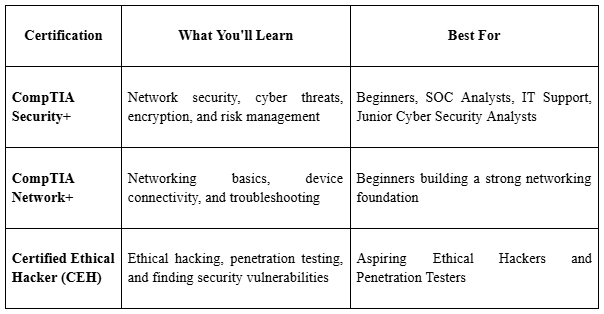
Section 1: Beginner-Friendly Certifications
If you’re new to IT or security, start with this.
Also read about what a Cyber Security course should cover.
Intermediate and Professional Certifications
Once you have 2–5+ years of experience, you can check out the following certifications:
How to Choose a Certification Path
Don’t chase every acronym; map the certification to where you actually want to sit in a security team.
- Career stage first: If you have under two years of experience, prioritize Security+ or the Google Cert before anything requiring five years of documented work history.
- Time commitment: Entry-level certifications typically need 6–10 weeks of prep at a few hours a day. CISSP and CCSP often need 3–4 months given the breadth of domains covered.
- Prerequisites: Always check experience requirements before registering. CISSP and CISM in particular reject candidates who haven’t logged the required years, even after passing the exam (you’d hold an “Associate” status until experience catches up).
Study Resources and Certification Courses for Cyber Security
Self-study works for disciplined learners, but structured certification courses for Cyber Security cut down wasted time by aligning practice tests, labs, and mentorship to the actual exam blueprint. Look for courses that include timed mock exams, hands-on lab environments (not just video lectures), and doubt-clearing support the three things self-study is weakest at replicating.
At YuHasPro Institute Of Technology, our Cyber Security diploma program follows the same stage-by-stage approach: foundational modules for beginners, and advanced, specialized training for working professionals looking to move into the top security roles. You will learn with hands-on projects, flexible batch timings, and dedicated placement support.
Conclusion
After pursuing the certifications and the market trend, building a career in Cyber Security, like CompTIA Security+ or CompTIA Network+, will lead to building a strong foundation and a handsome package in a year, as per your performance. Additionally, if you want to gain more experience and opt for advanced certifications like CISSP or CISM when you meet the required experience. Choose certifications that match your career goals instead of following trends.
FAQs
1. How much time does it take to prepare for Security+ certification?
Usually, beginners need 6 to 10 weeks of studying daily. If you have prior experience, this timeline gets reduced. You have to be consistent, and it will work out.
2. Are Cyber Security certifications expensive?
Cyber Security courses are generally not very expensive. However, it depends on institutions as well. It is better to check for pricing before enrolling to avoid confusion.
3. Is a degree required before I enroll for these certifications?
No. To pursue any Cyber Security certification, it is not compulsory to have a degree. However, if you have prior knowledge about the basics, learning the details becomes much easier.
4. For how long is a Cyber Security certification valid?
Usually, there is no valid date for course certifications. However, it is important to check the institution’s policies to know about the credential validity.
5. Which certification should I get first if I’m switching careers?
You can go for CompTIA Security+ certification. It does not require previous experience in the field and is accepted by almost all institutions.