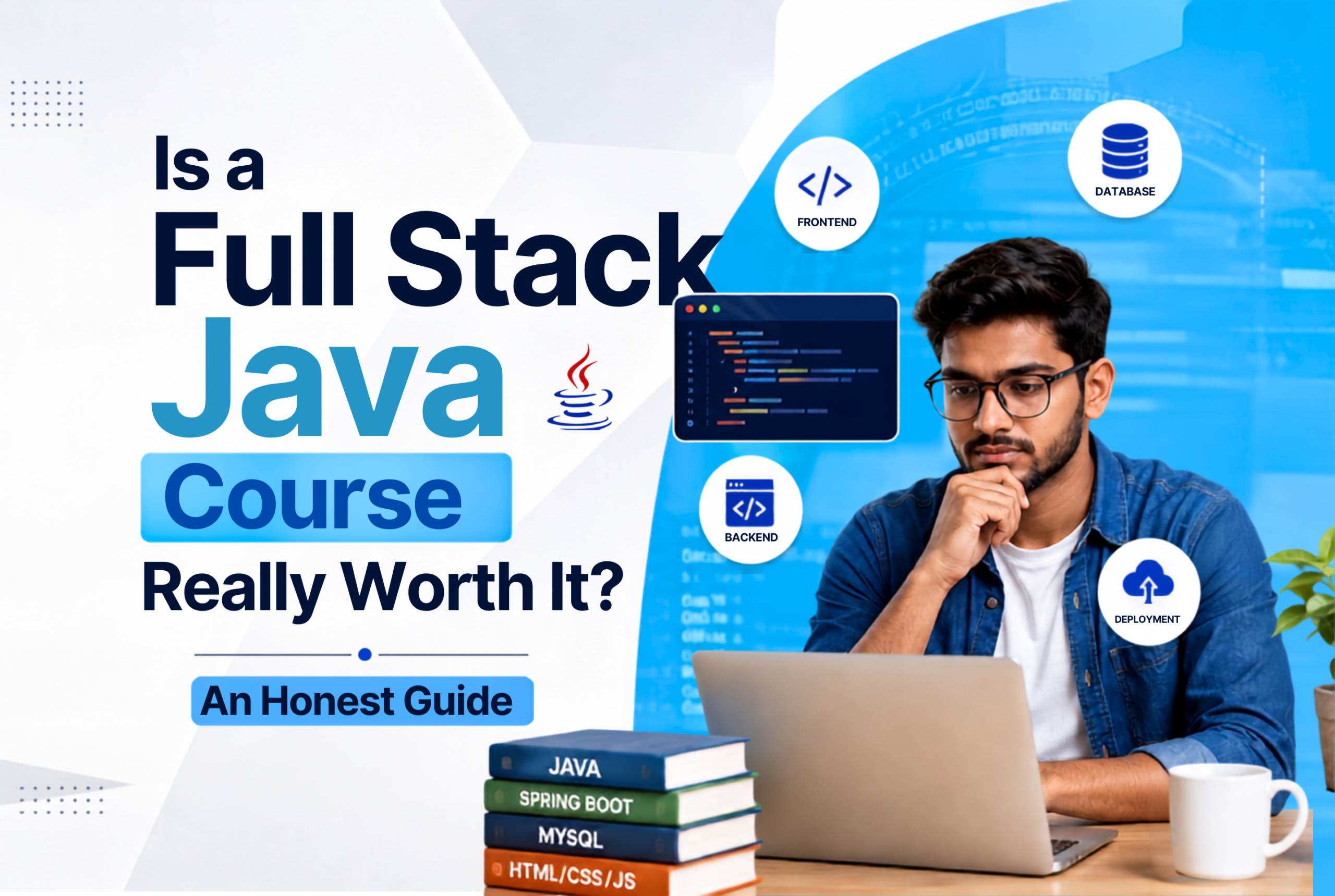
A lot of people get into Java full-stack development without really planning for it. One thing leads to another, and suddenly it starts making sense. You learn how a button works, then you get curious about what happens after you click it, and before you know it, you’re interested in both sides of the screen, the part people see, and the part that runs quietly behind it.
That’s really all full-stack means: front end, back end, and the ability to connect the two. And when Java comes into the picture, it gives that back end some real structure, the kind that companies actually build on, which is probably why Java Full Stack courses have been getting a lot more attention from people who want to go beyond the basics and into something genuinely career-ready.
It Usually Starts With Confusion
Most people don’t wake up one day and decide to become a full-stack Java developer. It usually takes planning, clarity, and consistent effort. It usually needs a lot of planning, decisions, and dedication.
You start with something small, maybe HTML, maybe a bit of Java. Then, suddenly, there are frameworks, databases, APIs, and tools you’ve never heard of. Everyone seems to be learning something different, and it can feel like you’re already behind. That’s where structured Java Full Stack courses start making a real difference.
That’s where having some direction actually helps.
Why Java Still Holds Its Ground
With so many languages out there, Java still manages to stay relevant. And not just “existing”; it’s actively used in large-scale systems, enterprise applications, banking platforms… places where stability actually matters.
That’s one reason people tend to choose a Full Stack Java course. It’s not just about learning syntax; it’s about understanding how real systems are built and maintained.
And once you start working with Java frameworks like Spring Boot, things begin to make more sense. You’re no longer writing random code; you’re building something structured.
Full Stack Isn’t About Doing Everything Perfectly
There’s a myth that full-stack developers are experts at everything. This is not what it looks like.
You’re not expected to master frontend design and backend architecture at the same level. It’s more about being comfortable moving between layers and knowing how things connect.
One day, you’re fixing a UI issue. Next, you’re debugging an API. It’s less about perfection, more about flexibility. That’s why a good Full Stack Java course focuses on how everything fits together, not just isolated topics.
Learning at Your Own Pace vs Learning with Guidance
This is where things get personal.
Learning styles differ, and that’s okay. Self-paced Full Stack Java courses suit those who like control, revisiting tricky concepts without pressure. Others need structure: fixed schedules, peers, and mentors available in real time when concepts get complex. Thane and Navi Mumbai have become solid tech education hubs for exactly this reason. In Nerul, the Best Full Stack Java course draws working professionals and career switchers seeking real, structured skills nearby. Showing up in person just makes procrastination harder.
The “Best Course” Isn’t Always the Loudest One
Every institute claims to be the best. Every ad promises results. But once you start looking closely, the difference becomes obvious.
Some courses focus too much on theory. Others rush through topics just to “cover” everything. And then there are a few that actually slow down where it matters, where you build projects, break things, fix them, and understand why something works.
Institutes that focus on live projects, mentor support, and practical implementation often stand out, and YuHasPro is one such name many learners consider while exploring career-focused training.
Conclusion
Becoming a Full Stack Java developer isn’t about ticking off a checklist. It’s about reaching a point where you can take an idea and turn it into something real. Something that runs, responds, and actually works. But here, one more important aspect also matters: choosing the right institute to learn and grow in this field.
Here comes the YuHasPro Institute of Technology. With industry-level training and live projects, YuHasPro offers dedicated placement assistance, mock interviews, resume guidance, and career support to help students prepare for real job opportunities, which helps students to land jobs of their dreams.
Whether you get there through a Full Stack Java course online or inside a classroom, the path looks different for everyone. Some people move fast, some take their time. Some need structure, others just need a starting point. None of that matters as much as one thing: showing up regularly and not stopping when it gets hard.
If you’re someone who wants to build a career in software development, choosing the right learning environment can make all the difference. With industry-focused training, live projects, and career guidance, YuHasPro helps learners turn technical skills into real career opportunities.
FAQs
1. Which institute is best for Java Full Stack training?
Look for live projects, mentor support, and placement assistance. YuHasPro Institute of Technology offers industry-level training with mock interviews and resume guidance. Thane and Nerul options are also worth exploring for commute-friendly, career-focused training.
2. Should I learn Java or C?
Java is better for most careers today, used in enterprise apps, web development, and Android. C builds strong fundamentals but offers fewer job opportunities in modern software development roles.
3. Should I take Java or Python?
Choose Java for full-stack web development and enterprise roles. Choose Python for data science, ML, and rapid prototyping. Your career direction should decide which language fits best.
4. Which is better for freshers: Java Full Stack or Python Full Stack?
Java Full Stack has a steeper curve but leads to higher-paying, stable enterprise roles. Python Full Stack is easier initially. For long-term corporate stability, Java is the stronger investment.
5. Which pays more, Java or Python?
Java developers generally earn more in enterprise and banking roles. Python developers in AI/ML niches can match or exceed that, depending on specialization and experience.