The demand for cloud professionals is growing faster than ever. From startups to global enterprises, companies are moving their operations to the cloud to improve scalability, security, and efficiency. This shift has created thousands of job opportunities for skilled cloud professionals across India and globally.
If you are looking for a Professional Cloud Computing Course in Thane & Nerul, now is the perfect time to start. Whether you are a student, fresher, or working professional, cloud computing can help you build a future-ready career with excellent salary growth.
In this blog, we will explore how cloud computing works, why it is one of the best IT careers today, and how the right course can help you become industry-ready.
What is Cloud Computing?
Cloud computing refers to delivering computing services such as servers, storage, databases, networking, and software over the internet rather than relying on physical hardware.
In simple words, cloud computing allows businesses to store data and run applications online without managing expensive infrastructure.
Popular cloud platforms include:
| Cloud Platform | Usage |
| Amazon Web Services (AWS) | Web hosting, storage, AI services |
| Microsoft Azure | Enterprise cloud solutions |
| Google Cloud Platform (GCP) | Data analytics and machine learning |
| IBM Cloud | Hybrid cloud and AI integration |
Today, almost every industry uses cloud technology, including healthcare, banking, e-commerce, gaming, education, and media.
Why Choose a Professional Cloud Computing Course Online?
An online professional cloud computing course helps learners gain practical skills that companies are actively hiring for. Unlike traditional theoretical learning, modern cloud courses focus on real-world projects, live deployments, and hands-on training.
Benefits of Learning Cloud Computing
- High-demand career opportunities
- Attractive salary packages
- Global job availability
- Work-from-home opportunities
- Easy transition into DevOps, AI, and cybersecurity
- Strong future career growth
Cloud computing is not limited to experienced IT professionals. Many institutes now offer Cloud computing courses for beginners, making it easier for students and freshers to start from scratch.
Cloud Computing with AI Course: The Future Combination
One of the biggest trends in technology today is the integration of Artificial Intelligence with cloud platforms. A Cloud Computing with AI course teaches learners how cloud infrastructure supports AI applications, machine learning models, and automation systems.
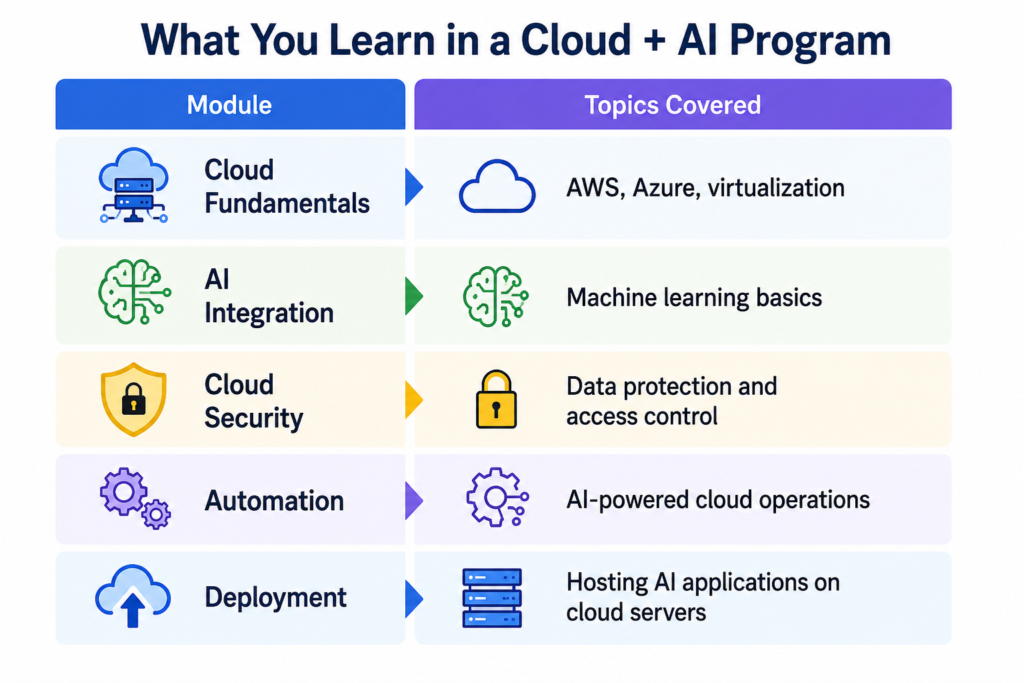
This combination gives students an extra advantage because companies are increasingly looking for professionals who understand both cloud and AI technologies.
Cloud Computing Courses with Placement Support
One of the biggest concerns for students is getting a job after course completion. That is why choosing Cloud computing courses with placement support becomes important.
Placement-oriented training programs usually include:
- Resume building
- Mock interviews
- Industry projects
- Internship opportunities
- Soft skills training
- Technical interview preparation
Institutes offering placement support help students become job-ready instead of only focusing on theory.
Top Job Roles After Cloud Computing Training
| Job Role | Average Starting Salary |
| Cloud Support Engineer | ₹3 – ₹5 LPA |
| AWS Cloud Practitioner | ₹4 – ₹6 LPA |
| DevOps Associate | ₹5 – ₹8 LPA |
| Cloud Administrator | ₹4 – ₹7 LPA |
| Cloud Security Analyst | ₹6 – ₹10 LPA |
Salary packages can grow significantly with certifications and experience.
Cloud Computing Online Courses with a Certificate
Many learners today prefer flexibility, which is why online cloud computing courses with a certificate are becoming highly popular.
Online learning allows students and professionals to:
- Learn from anywhere
- Access recorded sessions
- Practice on cloud labs
- Study at flexible timings
- Balance education with work or college
A recognized certificate helps validate your skills and improves your chances of getting shortlisted during job applications.
Why Certifications Matter?
Cloud certifications prove your practical knowledge to employers. Some popular certifications include:
- AWS Certified Cloud Practitioner
- Microsoft Azure Fundamentals
- Google Associate Cloud Engineer
- AWS Solutions Architect Associate
These certifications strengthen your resume and increase your credibility in the IT industry.
Who Should Join a Cloud Computing Course?
Cloud computing is suitable for almost anyone interested in technology.
Ideal Learners Include:
- IT and Computer Science students
- BCA, BSc IT, and Engineering graduates
- Working professionals looking for career growth
- Software developers
- Network engineers
- Beginners entering the IT field
The best part is that many institutes now offer Cloud computing courses for beginners, making it easier for non-technical learners to understand concepts step by step.
Skills You Gain During Training
A professional cloud computing course helps students build both technical and practical skills.
Technical Skills
| Skill | Importance |
| Cloud Infrastructure | Core foundation of cloud systems |
| Linux Basics | Essential for server management |
| Networking | Understanding internet architecture |
| Virtualization | Managing cloud resources |
| Security Management | Protecting cloud environments |
| Deployment Tools | Hosting applications efficiently |
Soft Skills
- Problem-solving
- Team collaboration
- Communication
- Project management
- Analytical thinking
These skills make candidates more employable in the modern IT industry.
Why Cloud Computing is One of the Best IT Careers Today
The cloud industry is growing rapidly because businesses want scalable and cost-effective solutions. According to industry reports, cloud adoption will continue increasing across all sectors over the next decade.
Reasons Behind the Demand
- Increased remote work culture
- Growing use of AI and big data
- Digital transformation across industries
- Need for secure data storage
- Expansion of SaaS platforms
Because of this demand, companies are continuously hiring cloud professionals with practical skills and certifications.
How to Choose the Right Cloud Computing Course
Before enrolling in a course, students should check the following factors:
Important Checklist
| Factor | Why It Matters |
| Updated Curriculum | Covers the latest industry tools |
| Hands-on Projects | Improves practical learning |
| Placement Support | Helps with job opportunities |
| Expert Trainers | Better industry guidance |
| Certification | Adds value to your resume |
| Live Training | Interactive learning experience |
Choosing the right institute can make a major difference in your learning and career growth.
Cloud Computing Career Scope in India
India is becoming a major technology hub, and cloud computing professionals are in huge demand across cities like Mumbai, Pune, Bangalore, Hyderabad, and Chennai.
Top companies hiring cloud professionals include:
- TCS
- Infosys
- Accenture
- Wipro
- Capgemini
- Amazon
- Microsoft
Even startups are heavily investing in cloud infrastructure, creating more opportunities for freshers and skilled professionals.
Conclusion
Cloud computing is no longer just a trending technology; it has become one of the most in-demand career paths in the IT industry. From startups to global companies, businesses are actively looking for skilled cloud professionals who can manage modern digital infrastructure and AI-powered systems. With the right training, certifications, and practical experience, cloud computing can lead to excellent career growth and high-paying job opportunities.
That’s where YuHasPro helps you stand out. At YuHasPro, our Professional Cloud Computing Course is designed with hands-on learning, real-time projects, expert mentorship, and placement support to make you industry-ready. Whether you choose a Cloud Computing with AI course, a Professional cloud computing course online, or Cloud computing online courses with a certificate, YuHasPro provides the practical skills and guidance needed to build a successful future in tech.
FAQ
1. What are the 4 types of cloud computing?
The four main types of cloud computing are Public Cloud, Private Cloud, Hybrid Cloud, and Community Cloud. Public cloud services are shared online, private clouds are dedicated to one organization, hybrid clouds combine both, and community clouds are shared among organizations with similar requirements, like security or compliance needs.
2. What is the Big 3 of cloud computing?
The Big 3 cloud providers are Amazon Web Services (AWS), Microsoft Azure, and Google Cloud Platform (GCP). These companies dominate the cloud industry by offering services like data storage, virtual servers, AI tools, networking, cybersecurity, and application hosting for businesses worldwide across multiple industries.
3. Which is better, cloud or DevOps?
Cloud computing and DevOps are both valuable career paths, but they serve different purposes. Cloud focuses on infrastructure, storage, and deployment, while DevOps improves software development and automation processes. Learning both together provides better career opportunities because modern companies often integrate DevOps practices with cloud platforms.
4. How many models are there in cloud computing?
Cloud computing mainly has three service models: Infrastructure as a Service (IaaS), Platform as a Service (PaaS), and Software as a Service (SaaS). These models help businesses choose different levels of cloud services depending on their requirements for infrastructure management, application development, and software accessibility.
5. What is a cloud salary?
Cloud computing professionals earn competitive salaries due to high industry demand. Freshers can start with packages around ₹3–₹6 LPA, while experienced professionals can earn ₹10 LPA or more. Salaries vary based on certifications, cloud platforms expertise, job role, practical experience, and company requirements in the IT industry.